
Narrative Sovereignty: Why Africa Must Define Itself
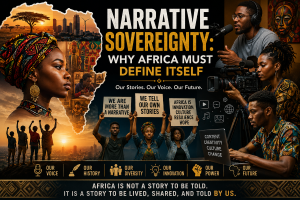
Narrative Sovereignty: Why Africa Must Define Itself
(Media Portrayal of Africa)
By Lakomekec Kinyera (Anthony)
Introduction
When Africa appears in global media, it is often portrayed through familiar narratives of crisis including; conflict, poverty, disease outbreaks, corruption, and humanitarian emergencies. These issues are real and deserve attention. However, they do not fully capture the complexity and diversity of African societies.
The problem, therefore, is not necessarily one of accuracy but of imbalance. When the same themes repeatedly dominate international coverage, Africa is viewed through a narrow lens that overlooks important stories of development, adaptation, governance reform, innovation, and everyday life.
This essay explores the question: How should Africa be framed truthfully, responsibly, and constructively for Africans and the world? It argues that Africa needs a more balanced, contextual, and agency-driven form of representation, rooted in narrative sovereignty – the ability of African people and institutions to play a meaningful role in shaping how their realities are understood and communicated.
Truth, Framing, and the Problem of Selective Visibility
The media does not simply mirror reality; it shapes public understanding through choices about what to reveal, what to repeat, and what to leave out. What becomes visible is not only what exists, but also what is consistently selected for attention of the community.
In Africa’s case, the main concern is not outright misrepresentation but selective visibility. Stories linked to conflict, disasters, and emergencies often receive greater attention because they are immediate and considered highly newsworthy. Over time, this creates an imbalance where Africa is largely associated with instability and crisis.
This is not misinformation in the strict sense, but, rather, it creates what might be called a contextual distortion, where accurate events are presented without sufficient balance, resulting in an incomplete picture of reality.
A truthful portrayal of Africa should therefore go beyond factual accuracy and strive for proportionality, ensuring that the full range of experiences and realities across the continent is reflected in the story conveyed by the respective media.
What Responsible Framing Must Correct
A responsible approach to representing Africa must address three recurring distortions.
The first is the dominance of crisis narratives. When conflict, disease outbreaks, and humanitarian emergencies receive the most attention, they overshadow other aspects of life across the continent. While these issues are important and deserve coverage, they do not represent the full African experience.
The second is the lack of continuity. Media attention tends to focus on dramatic events rather than long-term processes of change. Stories about governance reforms, economic growth, technological innovation, and social transformation often struggle to attract the same visibility as crises.
Northern Uganda provides a clear example. For many years, the region was known internationally through coverage of the Lord’s Resistance Army insurgency. Reporting on this insurgency revealed abductions, displacement, and violence because these were the defining realities of the conflict. However, that image became the dominant way the region was understood.
Far less attention has been given to what happened afterward despite of communities spending years rebuilding livelihoods, resettling families, expanding education, growing businesses, and strengthening local institutions. Yet these recovery efforts have rarely received the same visibility as the conflict itself. The result is an incomplete picture in which crisis remains more visible than recovery and progress.
The third distortion is the erasure of agency. African people are often portrayed as passive recipients of aid rather than active participants shaping political, economic, and social change. Such portrayals overlook the role that communities, institutions, and individuals play in addressing challenges and creating opportunities.
Together, these distortions limit public understanding of Africa’s complexity and ongoing transformation.
Principles of Truthful and Constructive Framing
A more balanced representation of Africa should be guided by five principles: proportionality, contextualization, continuity, agency, and plurality. Coverage should reflect a range of realities rather than focusing overwhelmingly on crises.
Stories should be placed within their historical and social contexts, while recognizing long-term change rather than isolated events. African people should be portrayed as active decision-makers and problem-solvers, not merely as victims or beneficiaries of outside intervention.
Finally, representation must acknowledge Africa’s diversity. The continent is not a single story but a collection of societies, cultures, languages, and experiences that cannot be understood through one narrative alone.
Exploratory Media Framing Audit (31 May 2026)
To explore these issues, an exploratory content audit of an estimated 200 Africa-related headlines from selected external and African media outlets was conducted on 31 May 2026.
Findings
Table 2: African Media (n = 200)
| Category | Share (%) |
| Political & Governance | 32% |
| Business & Economy | 25% |
| Conflict & Security | 14% |
| Health Crisis | 10% |
| Humanitarian Issues | 3% |
| Culture & Arts | 6% |
| Education | 5% |
| Technology & IT | 5% |
Table 1: External Media (n = 200)
| Category | Share (%) |
| Conflict & Security | 28% |
| Political & Governance | 22% |
| Health Crisis | 15% |
| Business & Economy | 12% |
| Humanitarian Issues | 10% |
| Technology & IT | 6% |
| Culture & Arts | 4% |
| Education | 3% |
Interpretation of Findings and the Way Forward
Even within this limited snapshot, a clear difference emerges between how external and African media outlets portray Africa when reporting events unfolding.
External media coverage, according to the survey, places a much stronger emphasis on crisis-related stories. Conflict and security account for 28% of the headlines reviewed, while health crises and humanitarian issues make up 15% and 10% respectively. Together, these categories represent more than half (53%) of all sampled headlines.
This does not mean the stories are inaccurate, but, rather, it suggests that Africa is often presented through a lens that prioritizes instability, emergencies, and risk.
African media tells a somewhat different story. Political and governance issues account for the largest share of coverage at 32%, followed by business and economic reporting at 25%. Crisis-related themes make up 27% of the headlines, indicating a broader and less crisis-centered approach to reporting. While challenges remain newsworthy, they share space with stories about governance, development, and economic activity.
Across both media systems, technology, education, and culture receive relatively limited attention. Even so, African media gives these areas slightly greater visibility than external outlets.
These findings should be treated with caution since in my survey, the audit covers only a single day of reporting and is not intended to provide definitive conclusions about long-term media behavior. Nevertheless, it offers a useful glimpse into how different media systems may prioritize different aspects of African reality.
The significance of the audit lies not in statistical certainty but in what it reveals about representation. Africa is not being framed through one shared narrative. Different media institutions reveal different realities, and those choices influence how audiences understand the continent.
This audit raises an important question: “who decides which stories are seen, remembered, and discussed?” The issue is not only about the content of reporting but also about narrative authority, the power to shape public understanding on Africa.
This is where the idea of narrative sovereignty becomes important. In my essay, I defined Narrative sovereignty as; the ability of African journalists, scholars, institutions, and communities to play a leading role in telling their own stories. It does not mean rejecting international reporting or limiting outside perspectives, but, ensuring that African voices are equally present in shaping how events are interpreted and understood.
A more balanced approach to framing Africa should combine three elements. These include;
- First, media must continue reporting immediate events such as conflicts, elections, disasters, and political developments.
- Second, reporting should examine the structural conditions behind those events, including governance systems, economic realities, and demographic changes.
- Third, it should pay attention to long-term trajectories such as technological innovation, entrepreneurship, urbanization, educational progress, and institutional reform.
Taken together, these layers provide a fuller picture of African societies, and that, the goal is not to replace negative stories with positive ones, but to create a more complete and accurate representation. Africa’s story includes challenges, but it also includes resilience, creativity, recovery, and transformation. A truthful portrayal must make room for all of these realities.
This chart below presents a comparative analysis of Africa-related front-page headlines across two media systems: ten external international outlets and ten African media platforms. Based on a coded sample of approximately 200 stories per system, each story was assigned a single dominant category under an eight-theme framework derived from agenda-setting theory.
The visualization reveals a clear divergence in thematic emphasis, with external media showing higher crisis-oriented framing, while African media demonstrate a more diversified distribution across governance, economic, and developmental categories.
Ultimately, Africa does not need a more positive image; it needs a more complete one. The challenge is not whether crises should be reported, but whether they should define a continent of over a billion people.
Narratives influence policy, investment, development priorities, and how societies see themselves. A truthful and responsible framing of Africa must balance challenges with context, progress, and agency. Narrative sovereignty is therefore more than a media issue, it is a development imperative that ensures Africa is understood in its full complexity and potential.