
THE CHILD NEVER ASKED TO BE BORN INTO STRUGGLE, Why Parenthood Requires More Than the Desire to Have a Child
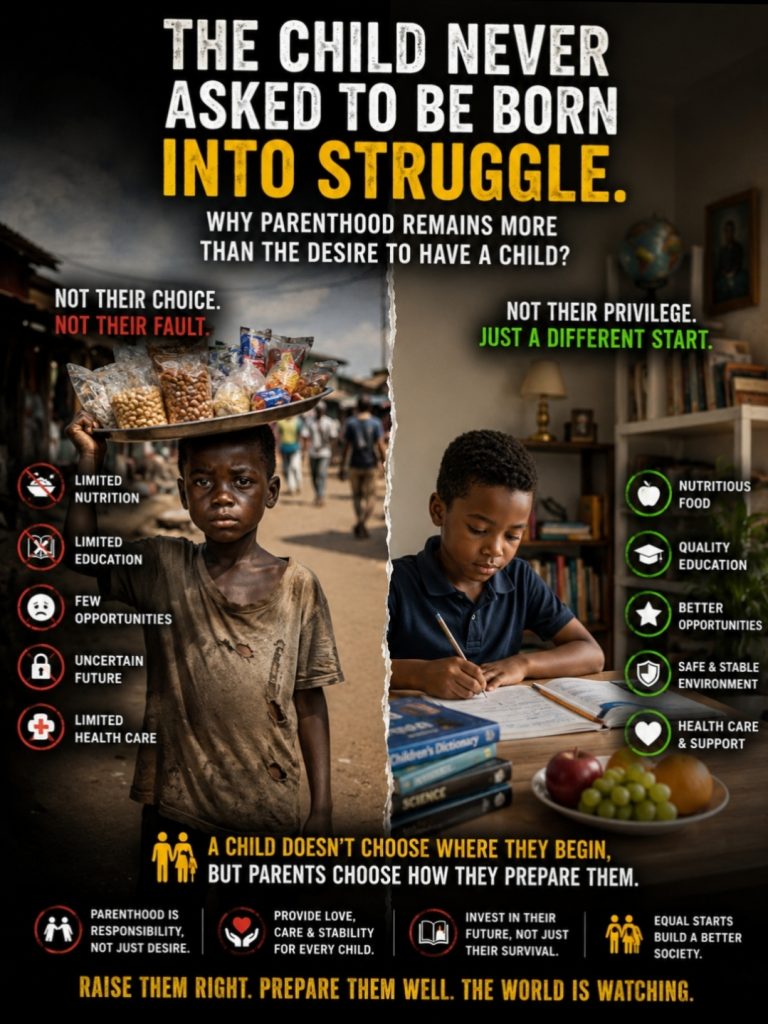
THE CHILD NEVER ASKED TO BE BORN INTO STRUGGLE
Why Parenthood Requires More Than the Desire to Have a Child
By: Bassey Margaret Ijeoma
There are some decisions in life that affect only the person making them. There are other decisions that affect another human being for the rest of their life. Having a child is one of those decisions.
A child does not choose to be born. A child does not choose their parents. A child does not choose whether they will grow up in a comfortable home or in a home where there is barely enough food to eat. A child does not choose whether they will attend a good school, have access to healthcare, have proper clothing, or sleep peacefully at night.
The adults make that decision for them.
This is why having children should never be treated as something that requires only desire. It requires responsibility, preparation, sacrifice, and serious thinking.
There is nothing shameful about being poor. Many hardworking people are struggling financially through no fault of their own. People can lose their jobs, businesses can fail, economies can become difficult, and unexpected problems can completely change a family’s financial situation.
However, there is an important question that every person should ask before deliberately bringing a child into the world:
If I am already struggling to take care of myself, am I truly prepared to take responsibility for another human being?”
That question may be uncomfortable, but it is necessary.
A Child Is Not Just a Baby
Sometimes people think about having children mainly in terms of the excitement of having a baby. They imagine the pregnancy, the naming ceremony, the photographs, the celebrations, and the happiness of holding a newborn.
But a baby does not remain a baby forever.
The cute baby eventually becomes a child who needs food every day. That child needs clothes, education, healthcare, transportation, protection, attention, guidance, and emotional support. Eventually, the child becomes a teenager with even greater needs and responsibilities.
This is where the real meaning of parenthood begins.
Having a child is easy compared with raising one properly.
Giving birth takes one moment, but raising a human being takes many years of sacrifice.
A parent cannot simply say, “I wanted a child,” and stop there. The bigger question is, “What kind of life can I give this child?”
Love Alone Is Not Always Enough
One of the most common things people say is, “As long as I love my child, everything will be fine.”
Love is extremely important. Every child deserves to be loved.
But love alone cannot solve every problem.
A parent can love a child deeply and still struggle to provide food. A parent can love a child and still be unable to pay school fees. A parent can love a child and still be unable to afford proper medical care.
A hungry child cannot eat love.
A sick child cannot receive medical treatment through love alone.
A child who needs education cannot pay school fees with love.
This does not mean money is everything. It simply means that love and responsibility must work together.
A good parent should want to provide both emotional support and basic physical needs.
The Child Pays the Price
The saddest part of bringing a child into severe financial hardship is that the child often has no control over the situation.
Imagine a child waking up in the morning and there is nothing to eat.
Imagine that child going to school without proper books because the parents cannot afford them.
Imagine being sent home from school because fees have not been paid.
Imagine becoming sick and watching your parents panic because they cannot afford treatment.
Imagine watching other children enjoy opportunities that you cannot have simply because your family cannot afford them.
The child may begin to ask questions:
Why am I suffering?
Why can’t I have what other children have?
Why can’t I go to school?
Why am I always hungry?
The child did not create the situation.
The child did not ask to be born.
Yet the child may be the one carrying the consequences.
That is what makes responsible parenthood so important.
Poverty Is Not a Crime
It is important to make something very clear: being poor does not make someone a bad person or a bad parent.
There are poor parents who would do anything for their children. There are parents with very little money who work extremely hard, sacrifice their comfort, and give their children everything they possibly can.
Some people become poor because of circumstances beyond their control.
A person can have a job today and lose it tomorrow.
A business can succeed today and fail tomorrow.
A family can be financially stable today and face a serious crisis tomorrow.
Life is unpredictable.
Therefore, nobody should be insulted simply because they are struggling financially.
The issue is different when someone is already unable to meet the basic needs of the children they have and continues deliberately having more children without considering the consequences.
At that point, we need to talk about responsibility.
“God Will Provide” Is Not a Complete Plan
Faith can give people hope during difficult times. Many people believe that God will provide, and there is nothing wrong with having faith.
But faith should not become an excuse for refusing to plan.
If someone knows they cannot afford to feed another child and simply says, “God will provide,” they are still placing the consequences of that decision on the child.
Responsible parenthood requires both hope and preparation.
You cannot refuse to plan for tomorrow and then blame tomorrow when things become difficult.
If you know that your income is already barely enough for your existing family, it is reasonable to think carefully before adding another responsibility.
Children Should Not Be Used to Solve Adult Problems
Another problem is having children for the wrong reasons.
Some people have children because they believe a baby will save a failing relationship.
Some have children because their parents are putting pressure on them.
Some have children because they want someone to take care of them when they become old.
Some have children because they believe having many children will somehow bring them wealth.
Some simply say, “Everyone is having children, so why shouldn’t I?”
But a child should not be brought into the world to solve an adult’s problem.
A child is not a relationship repair tool.
A child is not a retirement plan.
A child is not a financial investment.
A child is a human being who deserves to be loved, protected, educated, and given an opportunity to build their own life.
“Who Will Take Care of Me When I Am Old?”
This is a common reason people give for having many children.
They say, “When I grow old, my children will take care of me.”
But children should not be brought into the world simply because parents expect them to become their future source of income.
Children grow up and have their own lives.
They may have their own families, jobs, responsibilities, and struggles.
A responsible parent should try to build their own future rather than putting the entire responsibility of their old age on children who have not even been born yet.
More Children Means More Responsibility
Having one child and having five children are not the same responsibility.
Every additional child requires additional food, clothing, education, healthcare, time, attention, and protection.
This is why family planning is important.
Family planning does not mean telling people never to have children. It means helping individuals and couples make informed decisions about when to have children, how many children they can reasonably support, and how to space pregnancies.
There is wisdom in saying:
“Let me take care of the children I already have before bringing another child into this family.”
That is not selfishness.
That is responsibility.
You Don’t Have to Be Rich Before Having Children
At the same time, we should not take this argument to the extreme.
You do not need to own a mansion.
You do not need to drive an expensive car.
You do not need to have millions in your bank account.
You do not need to give your children everything they ask for.
Children do not need luxury to be happy.
What they need are basic necessities, safety, love, guidance, education, healthcare, and a reasonable opportunity to grow.
A family may have very little money and still raise wonderful children.
The question is not:
“Am I rich?”
The question is:
“Am I responsible enough and stable enough to provide the basic things this child needs?”
That is a much more reasonable question.
Think About the Future, Not Just Today
Before having a child, people often think about the present.
Responsible parenthood means thinking beyond the desire to have a baby. Before having a child, parents should consider whether they can provide food, shelter, education, healthcare, attention, and a safe environment, both now and if unexpected difficulties arise.
Children deserve more than mere survival.
They deserve the opportunity to learn, dream, develop their talents, receive proper healthcare and education, feel safe, and grow into their full potential. Poverty can make these basic opportunities harder to provide, which is why careful planning and preparation before parenthood are important.
Society Also Has a Role to Play.
The responsibility of raising children should not fall entirely on parents. Society and government also have an important role to play in helping families build better lives. When people have access to good education, employment, healthcare, family-planning information, and social support, they are more likely to make better decisions about when to have children and how many children they can reasonably support.
Poverty is not solved simply by telling poor people to stop having children. We must also ask why so many families remain trapped in poverty in the first place. Creating jobs, improving education, making healthcare more affordable, and providing proper family-planning education can help people make informed decisions rather than decisions based on pressure, desperation, or lack of knowledge.
At the same time, individuals must understand that having a child is a serious responsibility.
Parenthood is not only about wanting a baby; it is about being prepared to raise a human being.
Before deciding to have a child, a person should think beyond the excitement of having a baby. They should think about food, shelter, education, healthcare, safety, emotional support, and the future. A child will depend on their parents for many years, and the decisions made by those parents can have a lasting effect on the child’s life.
This brings us to an important difference: wanting a child and being ready to raise a child are not the same thing.
Someone may desperately want a baby because they love children, feel lonely, are getting older, or because their family is putting pressure on them. But those reasons do not automatically mean that the person is prepared for the responsibility of parenthood.
The most important person in this discussion is ultimately the child.
The child did not choose to be born. They did not choose their parents, their financial circumstances, or the environment into which they were born. Adults make those decisions on their behalf. Therefore, adults should think carefully about the consequences of those decisions.
This does not mean that parents must be rich before having children. Nobody can predict the future, and even financially comfortable families can suddenly experience unemployment, illness, or other unexpected problems. The goal is not perfection. The goal is responsibility and preparation.
If someone is already struggling to provide basic needs for the children they have, it is reasonable to ask whether having another child is the right decision at that moment. Instead of simply thinking, “I want another baby,” they should also ask, “Can I realistically provide for this child without making the situation worse for the children I already have?”
A child should never be brought into the world simply because society expects it, because everyone else is having children, or because the parents hope that the child will eventually take care of them in old age. A child is not a retirement plan, a solution to loneliness, or a way to fix a broken relationship.
A child is a human being with their own future.
They deserve food, education, healthcare, safety, love, guidance, and the opportunity to discover their abilities and pursue their dreams. They deserve more than simply being kept alive. They deserve an opportunity to live with dignity.
Conclusion
Having children is not wrong, and being poor is not a crime. Many hardworking parents struggle financially while doing everything they can to give their children a better future. Life can also change unexpectedly, and no parent can guarantee that their family will never experience hardship.
However, the fact that life is unpredictable does not mean we should stop planning.
Before bringing a child into the world, we should think carefully about the responsibility we are accepting. We should consider whether we can provide the child’s basic needs and whether we are emotionally and financially prepared to raise another human being.
The question should not simply be:
“Do I want a child?”
It should also be:
“Am I ready to raise one?”
There is a big difference between the two.
Wanting a child is a desire.
Raising a child is a responsibility.
The child never asked to be born into poverty. The child never asked to struggle. The child never chose the circumstances of their birth.
That is why, before bringing another life into the world, we should think beyond our own desires and consider the life that child will have to live.
Because becoming a parent is not simply about bringing a child into the world. It is about being prepared to give that child a fair chance in it.