

Leadership Beyond Stereotypes:
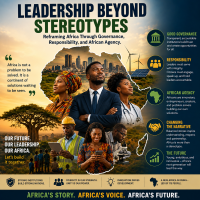
Leadership Beyond Stereotypes:
(Reframing Africa Through Governance, Responsibility, and African Agency)
By: Godiya Haruna-Peter
Africa has become one of the most narrated continents in the world, yet paradoxically one of the least understood. For decades, the continent has been framed through competing extremes: as a landscape of perpetual crises or as the next frontier of limitless economic opportunity. Neither narrative fully captures Africa’s complexity. Both flatten its diversity, diminish its agency, and often obscure the leadership choices that shape its realities.
For Nigeria, Africa’s most populous nation and one of its largest economies, this question is particularly urgent. How Africa is perceived globally influences investment, diplomacy, security partnerships, migration policies, and even the confidence Africans have in their own institutions. More importantly, how Africans choose to frame themselves influences the kind of leadership they demand and the governance culture they sustain.
The responsibility for telling Africa’s story cannot rest solely with foreign media, international institutions, or external observers. Africans themselves must become the principal authors of the continent’s narrative-not through public relations campaigns or romantic nationalism, but through truth, accountability, and responsible leadership. The challenge is not merely to improve Africa’s image but to improve the realities that define that image.
This begins with leadership.
Nigeria’s governance experience illustrates both the promise and the contradictions of African leadership. Since returning to democratic rule in 1999, the country has witnessed peaceful transfers of power, institutional reforms, technological innovation, and the emergence of a vibrant civic space. At the same time, persistent corruption, insecurity, weak public service delivery, unemployment, and declining public trust continue to undermine democratic legitimacy.
These realities cannot be dismissed as products of colonial history alone, nor should they be exaggerated into evidence of African incapacity. Mature societies confront uncomfortable truths without allowing them to become permanent identities. The same principle should guide Africa’s self-understanding. Truthful framing requires intellectual honesty. Africa possesses some of the world’s fastest-growing cities, the world’s youngest population, expanding digital economies, and remarkable entrepreneurial talent. Yet it also struggles with governance deficits, institutional weaknesses, political instability in some regions, and uneven development. A responsible narrative must hold these realities together rather than choosing one at the expense of the other.
Unfortunately, public discourse often rewards sensationalism over nuance. International headlines frequently spotlight conflict, coups, humanitarian crises, and corruption because these stories attract attention. Conversely, some African leaders respond by portraying criticism as hostility, insisting on overly optimistic narratives that deny legitimate governance failures. Both approaches ultimately weaken public trust.
Constructive framing demands a different path.
Leadership is not the art of image management; it is the discipline of institution-building. Nations earn positive reputations not because they market themselves effectively but because they govern effectively. Singapore, Rwanda, Botswana, and several Asian and European countries have demonstrated that international perception changes when domestic institutions consistently deliver results. Credibility is accumulated through transparent governance, predictable policies, functioning infrastructure, quality education, respect for the rule of law, and accountable public institutions. Narrative follows performance. Nigeria therefore faces a strategic choice. It can continue investing significant energy in defending its reputation, or it can prioritize reforms that naturally reshape global perceptions. The latter is both more difficult and more sustainable.
Good governance begins with a renewed understanding of public office. Political leadership should not be viewed as an avenue for personal enrichment or patronage but as stewardship of collective resources. Citizens increasingly judge governments not by campaign promises but by measurable outcomes: reliable electricity, accessible healthcare, quality education, employment opportunities, public safety, and efficient public services. This shift from rhetoric to results requires institutions that outlast individual leaders. Strong democracies are built less by exceptional personalities than by effective systems. Electoral commissions, anti-corruption agencies, civil services, judicial institutions, local governments, and oversight bodies must possess sufficient independence and capacity to function regardless of political transitions.
Equally important is ethical leadership. Integrity remains one of the most valuable yet underappreciated public assets in governance. Where leaders model transparency, respect for institutions, and fiscal responsibility, citizens are more likely to comply with laws, pay taxes, and participate constructively in democratic processes. Leadership culture shapes civic culture. However, responsibility does not belong exclusively to governments. Africans themselves must reject narratives of helplessness. Civil society organizations, journalists, academics, entrepreneurs, artists, faith communities, and young people all contribute to how the continent is understood, both internally and externally. Constructive patriotism requires the courage to celebrate genuine progress while speaking honestly about persistent failures.
The role of scholarship is particularly significant. African researchers must produce rigorous evidence capable of informing policy rather than merely reacting to political events. Universities should become laboratories for governance innovation, generating practical solutions to challenges such as urbanization, climate adaptation, food security, healthcare financing, digital governance, and public sector reform. Similarly, the media bears considerable responsibility. Responsible journalism neither sanitizes governance failures nor sensationalizes them. It contextualizes problems, investigates solutions, amplifies evidence-based debate, and holds leaders accountable without reinforcing harmful stereotypes about entire societies.
Young Africans also represent a transformative force in reshaping continental narratives. More than 60 percent of Africa’s population is under the age of 25. This demographic reality presents both opportunity and risk. If governments invest in education, digital infrastructure, entrepreneurship, and civic participation, Africa’s youth could become one of the greatest drivers of global economic and democratic renewal. If neglected, frustration may fuel instability, migration pressures, and declining institutional trust.
Nigeria offers encouraging examples despite persistent challenges. Its technology ecosystem has produced globally competitive startups. Nigerian writers, musicians, filmmakers, and other creatives continue shaping international culture. Members of the African diaspora contribute significantly to medicine, academia, finance, engineering, and innovation worldwide. These achievements demonstrate that African excellence is not exceptional- it becomes increasingly sustainable where enabling environments exist. Yet isolated success stories cannot substitute for systemic governance reform. Sustainable development requires moving beyond dependence on individual brilliance toward institutional excellence.
Africa’s relationship with the international community also deserves reconsideration. Partnerships should increasingly be defined by mutual interests rather than donor-recipient assumptions. Global actors have legitimate interests in Africa’s economic growth, environmental sustainability, security cooperation, energy transition, and expanding consumer markets. Likewise, African governments should negotiate international partnerships from positions of strategic confidence while maintaining transparency and accountability to their citizens. This also requires strengthening regional institutions. The African Continental Free Trade Area (AfCFTA) presents an opportunity not merely for economic integration but for demonstrating Africa’s collective capacity to coordinate policy, reduce trade barriers, and enhance regional competitiveness. Moreover, effective regional governance can strengthen Africa’s voice in global decision-making while improving economic resilience.
Ultimately, reframing Africa is less about communication strategy than governance strategy. The world’s perception of Africa will evolve most meaningfully when African societies consistently produce evidence of capable leadership, resilient institutions, democratic accountability, economic inclusion, and social justice. For Nigeria, this means embracing governance as a national development project rather than a periodic electoral contest. It means evaluating leaders through evidence instead of ethnicity, competence instead of patronage, and long-term institutional performance instead of short-term political victories. It also requires citizens to sustain democratic engagement between elections through informed participation, civic education, and community accountability.
The question, therefore, is not whether Africa should tell a more positive story. It should tell a more truthful one.
A truthful Africa acknowledges both its wounds and its possibilities. It refuses victimhood without denying history. It celebrates achievement without ignoring injustice. It demands accountability without surrendering hope.
The future of Africa’s global reputation will not be determined primarily in international newsrooms or foreign policy circles. It will be determined in classrooms where children receive quality education, in courtrooms where justice is administered impartially, in public offices where integrity triumphs over corruption, in communities where citizens actively participate in governance, and in governments that understand legitimacy is earned through service.
Africa does not need a new narrative detached from reality. It needs leadership capable of creating a new reality- one worthy of a confident, truthful, responsible, and constructive narrative authored first by Africans themselves. That is the leadership challenge before Nigeria. It is also the leadership opportunity before an entire continent.