
Addressing the Stereotype of Africa on Corruption
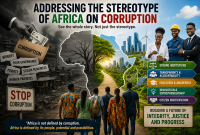
Addressing the Stereotype of Africa on Corruption
By: Tosin Omoniyi
Africa is a continent of immense diversity, rich history, and vast potential. It is too often reduced in the global imagination to a simplistic and damaging stereotype. Among the most pervasive and detrimental of these is the association of the continent with endemic corruption.
This perception is principally fueled by the media, historical narratives, and selective reporting. It paints a monolithic picture of African nations as inherently corrupt, a perception that ignores the complex realities on the ground, the varying degrees of governance across the continent, and the ongoing efforts to combat this malady.
While corruption is undoubtedly a significant challenge in many African nations, the prevailing stereotype is an oversimplification that hinders progress, perpetuates neocolonial attitudes, and obscures the continent’s resilience and commitment to good governance.
Historical Perspectives
The stereotype of African corruption has deep roots in colonial history and has been amplified by post-colonial narratives. During the colonial era, European powers often framed African societies as uncivilized and lacking the capacity for self-governance, a narrative that conveniently justified their exploitation of resources and imposition of their own systems.
Corruption was frequently used as a tool to divide and conquer, with colonial administrators sometimes engaging in or turning a blind eye to corrupt practices to maintain control. After independence, many African nations inherited weak institutional frameworks, artificial borders that often disregarded ethnic realities, and economies heavily reliant on the export of raw materials. This created fertile ground for corruption to take root, exacerbated by political instability, civil conflicts, and the challenges of nation building in a post-colonial world.
The advent of global media, particularly Western media outlets, has played a significant role in solidifying the stereotype. News coverage often prioritizes sensational stories of corruption, embezzlement, and kleptocracy, while underreporting instances of successful anti-corruption initiatives, democratic progress, or economic development. This selective framing creates a skewed perception, leading to an image of Africa as a continent perpetually plagued by graft
International financial institutions and development agencies, while often working to combat corruption, have sometimes contributed to the narrative through reports and assessments that, while factually based, can be generalized and reinforce existing biases. The focus on aid and development in Africa has often been framed through the lens of preventing funds from being siphoned off, implicitly reinforcing the idea that corruption is an inherent characteristic of African governance.
Multifaceted Nature of Corruption
It is important to recognize that corruption is not a monolithic entity; it exists in various forms and degrees across all societies, not just in Africa. Grand corruption, involving large-scale embezzlement of public funds by high-ranking officials, is a significant concern in many developing nations. However, petty corruption, such as bribery for essential services or minor administrative favors, also occurs and disproportionately affects the poor.
The causes of corruption are complex and deeply intertwined. They include weak legal and judicial systems, lack of transparency and accountability, inadequate public sector salaries, insufficient political will to combat it, and a culture that sometimes tolerates or even expects certain forms of patronage. Globalization and the interconnectedness of the global economy have also introduced new avenues for corruption, such as money laundering and illicit financial flows. Attributing corruption solely to an African characteristic ignores these universal drivers and the fact that corruption is a global problem present in every continent, from developed nations to developing ones.
For instance, scandals involving financial fraud, political bribery, and corporate malfeasance have been reported in Europe, North America, and Asia, demonstrating that corruption transcends geographical and economic boundaries
The Manifestation and Impact of the Stereotype
The stereotype of Africa as corrupt has profound and damaging consequences, both internally and externally. Externally, it perpetuates negative perceptions among potential investors, tourists, and international partners. This can lead to reduced foreign direct investment, a decline in tourism, and a reluctance of international organizations to engage with African governments, even when genuine efforts at reform are underway.
Internally, the stereotype can be self-fulfilling. When leaders and citizens internalize the narrative that corruption is an inescapable part of their society, it can breed cynicism and a sense of powerlessness, making it harder to mobilize collective action against corrupt practices. It can also be used by corrupt elites to deflect criticism and maintain their grip on power, arguing that their actions are simply in line with the African way; or are a necessary evil in a challenging environment.
The media’s role in reinforcing this stereotype is particularly problematic. Sensational headlines and a focus on negative stories can overshadow positive developments and the tireless work of civil society organizations, journalists, and reformist politicians who are actively fighting corruption.
Combating Corruption: African Agency and Progress
Despite the pervasive stereotype, it is crucial to acknowledge the significant and ongoing efforts by African nations to combat corruption. Many countries have established independent anti-corruption bodies, strengthened their legal frameworks, and ratified international conventions against corruption. Countries like Botswana and Rwanda have consistently ranked high in global corruption perception indices, demonstrating that effective governance and low levels of corruption are achievable. These successes are often the result of strong political will, robust institutional reforms, and active citizen engagement.
Civil society organizations across the continent play a vital role in holding governments accountable, raising public awareness, and advocating transparency. Investigative journalists risk their safety to expose corruption, and citizens are increasingly using technology and social media to demand accountability and report corrupt practices. Furthermore, regional bodies such as the African Union have adopted frameworks and conventions aimed at promoting good governance and fighting corruption. The African Union Convention on Preventing and Combating Corruption, for example, provides a legal framework for member states to implement anti-corruption measures.
The focus on good governance and anti-corruption efforts is not solely driven by external pressure but is increasingly an internal imperative for sustainable development and economic growth. African leaders and citizens recognize that corruption is a major impediment to achieving their development goals, attracting investment, and improving the lives of their people. They understand that tackling corruption is essential for building stable, prosperous, and democratic societies.
Conclusion
The stereotype of Africa as a continent defined by corruption is a harmful and inaccurate oversimplification. While corruption is a genuine challenge in many African countries, it is a global phenomenon with complex origins that are not unique to the continent. This stereotype is perpetuated by historical narratives, selective media portrayals, and a failure to acknowledge the significant efforts and progress being made by African nations to combat this issue.
The consequences of this stereotype are far-reaching, impacting foreign investment, international relations, and internal efforts towards good governance. It is essential to move beyond simplistic generalizations and recognize the diversity of experiences and the ongoing commitment of African leaders and citizens to build transparent, accountable, and prosperous societies.
A more nuanced understanding, one that acknowledges both the challenges and the remarkable progress, is crucial for fostering genuine partnership and supporting Africa’s continued development. Focusing on individual country contexts, celebrating successes, and supporting ongoing reform efforts will contribute to dismantling this damaging stereotype and fostering a more accurate and equitable global perception of Africa.