

The Benefits and Challenges of Online Learning
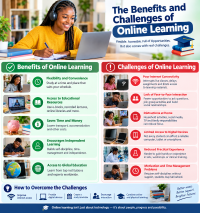
The Benefits and Challenges of Online Learning
By: Okunlola Christinan Omolola
Introduction
Online learning has become an important part of modern education. It allows students to learn through the internet using computers, tablets, and smartphones. With online learning, students can attend classes, watch educational videos, read digital materials, and complete assignments without necessarily being physically present in a classroom.
The growth of technology has made education more accessible to people in different parts of the world. However, despite its many advantages, online learning also presents challenges that can affect students’ academic performance and learning experiences.
Benefits of Online Learning
1. Flexibility and Convenience
Online learning allows students to study at a time and place that suits their schedules. This is especially helpful for students who combine education with work, family responsibilities, or other activities.
2. Access to Educational Resources
Students can access e-books, recorded lectures, online libraries, and educational videos. These resources help them understand difficult subjects and revise lessons whenever necessary.
3. Saves Time and Money
Online learning can reduce transportation costs, accommodation expenses, and other costs associated with attending a physical school. Students can learn from home without spending time travelling to school.
4. Encourages Independent Learning
Students are often responsible for managing their study schedules, completing assignments, and meeting deadlines. This helps them develop self-discipline, time-management skills, and independence.
5. Access to Global Education
Online learning gives students opportunities to attend courses offered by institutions and educators in other countries. They can develop new skills and gain knowledge that may improve their future career opportunities.
Challenges of Online Learning
1. Poor Internet Connectivity
Unstable internet connections can interrupt live classes, delay the submission of assignments, and prevent students from accessing learning materials. This can be a major challenge in areas with limited internet infrastructure.
2. Lack of Face-to-Face Interaction
Online students may have fewer opportunities to interact directly with teachers and classmates. This can make it difficult to ask questions immediately, participate in group activities, and build social relationships.
3. Distractions at Home
Students who study at home may be distracted by household activities, social media, television, or family responsibilities. Without a suitable study environment, it can be difficult to concentrate.
4. Limited Access to Digital Devices
Not every student owns a reliable computer, tablet, or smartphone. The cost of purchasing devices and paying for internet access can prevent some students from participating fully in online education.
5. Reduced Practical Experience
Some subjects require laboratory experiments, workshops, clinical training, or hands-on activities. These experiences can be difficult to reproduce through online classes alone.
6. Motivation and Time-Management Problems
Online learning requires students to remain committed even when teachers are not physically present. Students who struggle with motivation or time management may fall behind in their studies.
How to Overcome the Challenges of Online Learning
The challenges of online learning can be reduced through practical solutions.
-
Improve internet access: Governments, schools, and service providers should work towards making affordable and reliable internet available to more people.
-
Provide digital devices: Schools and organisations can support students by providing computers, tablets, and access to learning centres.
-
Create a study timetable: Students should set specific times for lessons, assignments, revision, and rest.
-
Encourage interaction: Teachers can organise virtual discussions, group projects, and question-and-answer sessions.
-
Combine online and physical learning: Where possible, schools can use a blended learning approach that combines digital education with classroom teaching and practical activities.
Conclusion
Online learning has transformed education by making it more flexible, convenient, and accessible. It provides opportunities for students to gain knowledge, develop new skills, and learn from different parts of the world. However, challenges such as poor internet connectivity, limited access to devices, distractions, and reduced face-to-face interaction can affect its effectiveness.
To achieve the best results, students, teachers, schools, and governments must work together to address these challenges. With proper planning, adequate technology, and effective teaching methods, online learning can become a valuable tool for improving educational opportunities and preparing students for the future.