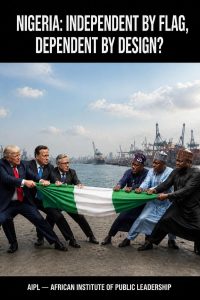

A Six-nation State for Nigeria to Ensure Security and National Cohesion

From Federation to Six Nation-States: Rethinking Nigeria’s Future for Security, Development and National Cohesion
Future World Magazine Editorial
Understanding Today, Defining Tomorrow
Nigeria stands at a critical historical moment. More than six decades after independence, the country continues to grapple with persistent security challenges, uneven development, governance inefficiencies, ethnic tensions, and recurring debates about the nature of the Nigerian federation.
Despite numerous constitutional amendments, political reforms, and institutional interventions, many of the fundamental questions that have confronted the nation since independence remain unresolved. These questions include:
- How can governance be brought closer to the people?
- How can the diversity of Nigeria become a source of strength rather than conflict?
- How can development be accelerated across all parts of the country?
- How can the federation remain united while respecting regional realities and aspirations?
These questions demand more than incremental adjustments, as is done through a four-yearly constitutional amendment processes. They require courageous national thinking.
The Case for a New Constitutional Architecture
One proposal deserving serious national conversation is the transformation of Nigeria into a Six Nation-State Federation, built around the existing geopolitical zones: South East Nation, South South Nation, South West Nation, North East Nation, North West Nation, Middle Belt Nation (formerly North Central), or whatever name each of these nation-states might decide to call themselves.
Under this arrangement, the six regions would become constitutionally recognized autonomous nation-states within a united Nigerian federation.
The Federal Government would retain responsibility for National Defence, Currency and Monetary Policy, Foreign Affairs, Citizenship and National Identity, and Strategic National Infrastructure. Most other responsibilities would be devolved to the six nation-states.
This would not represent the dissolution of Nigeria. Rather, it would represent a reimagining of Nigeria’s federal structure to make governance more responsive, accountable, and development-oriented.
Bringing Government Closer to the People
One of the enduring weaknesses of the current system is excessive centralization. Decisions affecting local realities are often made far from the communities that experience their consequences. Policies designed for a country of over 200 million people frequently struggle to reflect regional differences in culture, economy, geography, and social priorities.
A Six Nation-State model would allow each region to pursue development strategies tailored to its unique circumstances. The agricultural priorities of the North East differ significantly from the industrial aspirations of the South West. The environmental realities of the South South differ from those of the Middle Belt. Yet all are currently constrained by a heavily centralized framework. Greater regional autonomy could encourage innovation, competition, and accountability.
Security Through Local Ownership
Everyone knows that security remains one of Nigeria’s most urgent concerns. A major challenge of the current arrangement is the distance between security decision-making and local realities.
Regional governments with greater constitutional authority would be better positioned to understand local threats, coordinate community-based security responses, invest in region-specific security strategies, and address the social and economic conditions that fuel instability.
Anywhere around the world, security is often strongest when communities feel ownership of the institutions responsible for their protection. This is not the case with Nigeria and that explains the intractable nature of the Nation’s security challenge.
Managing Diversity Through Self-Governance
Nigeria’s diversity is one of its greatest assets, but it has also remained a source of recurring political tension. Many conflicts presented as ethnic or religious disputes are often rooted in deeper questions of power, representation, resource allocation, and governance.
A Six Nation-State structure could reduce these tensions by allowing regions greater freedom to shape policies that reflect their histories, cultures, and priorities while remaining part of a common Nigerian union.
Unity does not require uniformity. Strong federations around the world demonstrate that diversity can flourish when governance structures accommodate local realities rather than suppress them. There are numerous examples to accentuate this proposal.
A New Development Compact
Development rarely occurs through central directives alone.
It emerges when governments are close enough to citizens to understand their needs, mobilize local resources, and respond quickly to changing conditions.
Under a nation-state federation, region-nations could design their own economic strategies; educational systems could be adapted to local development goals; infrastructure priorities could reflect regional realities; and investment promotion could become more competitive and innovative. Such a model could stimulate healthy competition among regions while strengthening overall national prosperity.
The Centre Must Remain Strong
Advocating regional autonomy should not be mistaken for advocating national weakness. Indeed, a successful Six Nation-State Federation would require a strong and respected centre. This is because it will grant the Federal Government the right to continue to provide National defence, international representation, Monetary stability, strategic coordination, and Constitutional protection of rights and freedoms.
The objective is not to weaken Nigeria, but to create a federation in which both the centre and the regions function more effectively.
A Proposal for Debate, Not Division
Constitutional restructuring is neither a magic solution nor an easy undertaking. Any proposal of this magnitude must be approached with wisdom, consultation, and national consensus. Questions regarding revenue allocation, citizenship, minority rights, constitutional safeguards, and institutional transition would require careful consideration. Yet avoiding difficult conversations does not make challenges disappear. Nigeria’s future may depend not on preserving existing structures at all costs, but on having the courage to examine whether those structures still serve the nation’s long-term interests.
Defining Tomorrow
The greatest nations are not those that refuse to change. They are those that possess the wisdom to adapt when circumstances demand it.
The question before Nigeria is not whether unity should be preserved. We believe it should. But the real question is whether our current constitutional architecture remains the most effective vehicle for achieving security, prosperity, justice, and development for all Nigerians.
The proposal for a Six Nation-State Federation may not be the final answer. But it is a serious idea that deserves serious debate. That debate should start immediately. Civil society, the media, the academia, professional groups, and the National Assemble should take up the challenge right away.
As Nigeria looks toward the future, perhaps the time has come to ask not merely how to govern the country better, but whether the country itself should be governed differently. Only by asking bold questions can a nation discover bold solutions.
The future belongs to societies willing to rethink old assumptions in pursuit of a better tomorrow.
Future World Magazine 🌹 Editorial
Friday June 5, 2026