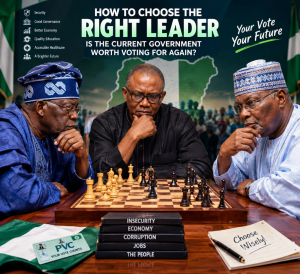

Is Four Years Actually Enough

FUTURE WORLD EDITORIAL
Is Four Years Actually Enough
There is a question that quietly sits beneath many political debates around the world: How much time does a leader need to make a difference?
In many democracies, the answer often offered is eight years. Some argue for even longer. Governments frequently explain unmet expectations by pointing to insufficient time, inherited challenges, institutional weaknesses, or the complexity of national problems.
Yet history suggests a different conclusion.
The greatest transformations in human societies have rarely depended on the length of leadership tenure. They have depended on the quality of leadership vision, the courage of decision-making, and the discipline of execution.
The future of nations is not determined by how long leaders remain in office. It is determined by what they choose to do with the time they are given. The assumption that four years is too short to transform a nation deserves serious reconsideration. Indeed, four years may be more than enough.
The First 1,000 Days
Future World proposes what we call the First 1,000 Days Principle of Governance. Most administrations reveal their true character within their first one thousand days in office. By that point, citizens can already answer fundamental questions.
Does the government have a clear vision? Does it possess a coherent plan? Has it assembled competent leadership teams? Are institutions becoming stronger or weaker? Is public trust increasing or declining? Is the nation moving forward or merely standing still?
The first one thousand days rarely determine whether every promise will be fulfilled. They do, however, reveal whether meaningful transformation has begun. History demonstrates that the direction of a nation is often established long before the completion of a leader’s tenure.
The Power of Strategic Decisions
Not all transformational leadership is measured by the number of projects commissioned or the volume of money spent. Sometimes a single decision alters the future of generations. Nigeria offers a compelling example.
When General Murtala Mohammed assumed leadership in 1975, few could have imagined that his brief tenure would leave an imprint lasting decades beyond his lifetime. Yet within months, his administration initiated reforms and embraced a recommendation that would permanently alter Nigeria’s national landscape: the relocation of the federal capital from Lagos to Abuja.
His time in office was measured in months. The consequences of his decisions continue to shape Nigeria half a century later. The lesson is profound.
Transformational leadership is not measured by duration. It is measured by the significance of decisions and the institutions they create. A leader may spend decades in office and leave little behind. Another may govern briefly and reshape history.
The Myth of Time
The argument that nations require long-serving leaders often confuses continuity with effectiveness. Time by itself does not produce development. Years do not build institutions. Tenure does not automatically create prosperity. Longevity cannot substitute for vision. The history of governance is filled with administrations that possessed abundant time but lacked direction.
Conversely, some of the most influential reforms in modern history emerged from leaders who understood the urgency of their moment and acted accordingly. The challenge facing nations is therefore not a shortage of time. It is a shortage of purposeful leadership.
The Four Pillars of Four-Year Transformation
A nation can experience significant transformation within four years when leadership is built upon four foundations.
Vision – Leaders must articulate a compelling picture of the future that citizens can understand and embrace. Transformation begins when people know where they are going.
Institution Building – The strongest leaders build systems that outlive them. Institutions, not personalities, sustain national progress.
Economic Repositioning – Every government must expand opportunity, productivity, and prosperity. Economic growth remains the most visible expression of effective governance.
National Cohesion – No society can prosper indefinitely while divided against itself. Great leadership creates a shared sense of purpose and belonging.
When these four pillars are pursued with seriousness and discipline, four years becomes sufficient time to establish a new national trajectory. Any leader that comes to office a clear vision of what to do, does not need more than four years to establish that, and probably leave the stage for others to continue or ask for another tenure of fours years to consolidate.
Leadership Beyond Re-Election
Perhaps one of the most important questions for modern democracies is whether leaders spend too much time preparing for the next election and too little time preparing the next generation.
The obsession with political survival often weakens governance. Too many administrations begin campaigning for a second term before completing the responsibilities of the first. As a result, political calculations replace strategic thinking.
Future-oriented leadership requires a different mindset. Leaders must see office not as a possession to be retained but as a stewardship to be fulfilled. The true test of leadership is not whether one remains in power. The true test is whether the nation becomes stronger because one served.
The Future Belongs to Decisive Leaders
The twenty-first century is moving at extraordinary speed. Technology is reshaping economies. Artificial intelligence is transforming industries. Climate change is redefining development
priorities. Demographic shifts are creating new opportunities and new pressures.
In such a world, nations cannot afford leadership cultures that spend years studying problems without implementing solutions. The future will reward governments that act decisively, think strategically, and build institutions capable of adapting to change. In this environment, four years is not a limitation. It is an opportunity.
A Final Reflection
History does not remember leaders primarily for how long they governed. History remembers what changed because they governed. It remembers ideas that became institutions. Institutions that became opportunities. Opportunities that improved the lives of ordinary people.
The question before every leader is therefore not whether four years is enough. The question is whether four years will be used wisely. For nations seeking renewal, prosperity, and purpose, the evidence of history is clear: Four years is enough time to begin transforming a country.
What is required is not more time. What is required is more leadership. Focused, visionary, prudent, and decisive leadership.
Future World Editorial, June 17, 2026