
The Future of Elections in Nigeria: Challenges and Opportunities
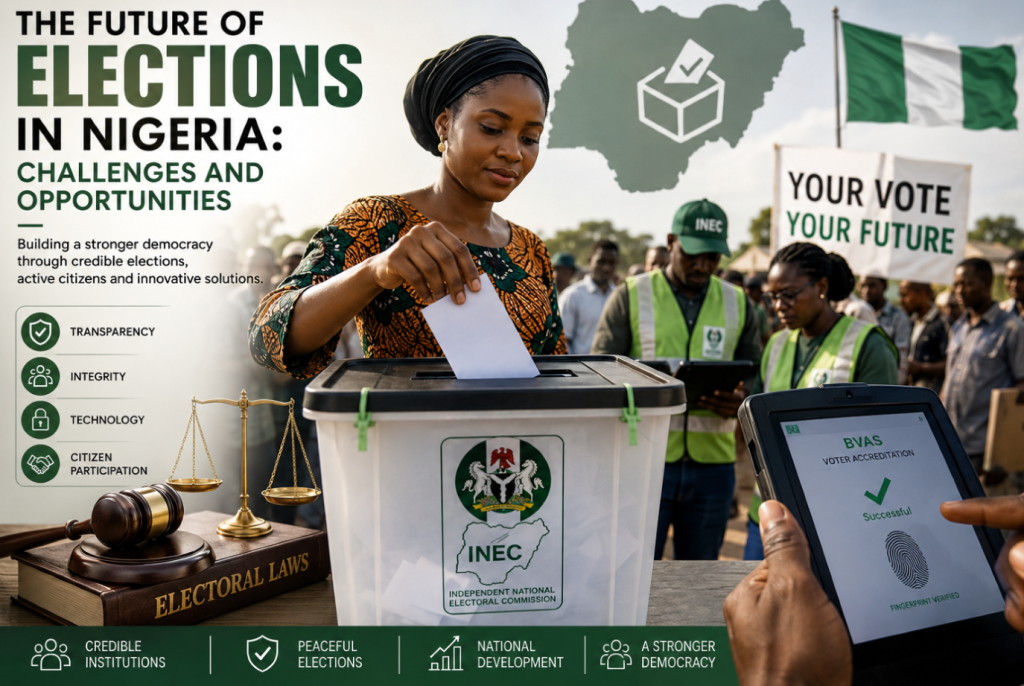
The Future of Elections in Nigeria: Challenges and Opportunities
By: Bassey Margaret
Introduction: Why Elections Matter
Elections are the heartbeat of every democratic nation. They provide citizens with the opportunity to choose their leaders, influence government policies, and determine the direction of their country. In Nigeria, elections are more than just a constitutional requirement; they are a powerful expression of the people’s will and a critical pillar of democratic governance.
Since Nigeria returned to democratic rule in 1999, the country has made remarkable progress in conducting regular elections. Citizens have consistently exercised their right to vote, governments have changed through the ballot box, and democratic institutions have become stronger. However, despite these achievements, the electoral process continues to face significant challenges, including voter apathy, electoral violence, vote-buying, misinformation, and logistical difficulties.
Looking ahead, the future of elections in Nigeria presents both enormous opportunities and pressing challenges. Advances in technology, increasing civic awareness, and ongoing electoral reforms have the potential to improve transparency and public confidence. At the same time, stakeholders must work together to address persistent issues that undermine the credibility of elections.
This article explores the future of elections in Nigeria, highlighting the major challenges, emerging opportunities, and practical steps that can strengthen the nation’s democracy.
Nigeria’s Electoral Landscape: Progress, Reforms, and Lessons Learned
Nigeria has conducted several general elections since the return to civilian rule in 1999. Each election has contributed valuable lessons that have shaped improvements in the country’s electoral system.
Over the years, the Independent National Electoral Commission (INEC) has introduced reforms aimed at making elections more transparent, credible, and efficient. These include biometric voter registration, the Bimodal Voter Accreditation System (BVAS), electronic transmission of results in many elections, and continuous voter registration.
These reforms have reduced some forms of electoral fraud, especially multiple voting and voter impersonation. Technology has also made it easier to verify voters and improve the accuracy of election results.
However, challenges still remain. Delays in election logistics, insecurity in some regions, legal disputes after elections, and allegations of irregularities continue to affect public confidence. These experiences demonstrate that while progress has been made, continuous improvement is necessary to build stronger democratic institutions.
Key Challenges Confronting Nigeria’s Electoral System
Although Nigeria’s democracy has grown stronger over the years, several challenges continue to threaten free and fair elections.
1. Voter Apathy
Many eligible Nigerians do not participate in elections because they believe their votes will not count. Others feel disappointed by previous leaders who failed to fulfill campaign promises.
Low voter turnout weakens democracy because elected leaders may not truly represent the majority of citizens.
2. Electoral Violence and Insecurity
Violence remains one of the biggest threats to elections. Political clashes, intimidation, destruction of election materials, and insecurity discourage many citizens from voting.
Fear should never determine whether citizens participate in choosing their leaders.
3. Vote-Buying and Electoral Malpractice
Some politicians attempt to influence voters through cash payments, gifts, or other incentives. Vote-buying weakens democracy because leaders may focus more on recovering campaign expenses than serving the people.
Electoral malpractice also includes ballot box snatching, falsification of results, and intimidation of electoral officials.
4. Misinformation and Fake News
The widespread use of social media has made it easier for false information to spread rapidly.
Fake election results, manipulated videos, and misleading political messages can confuse voters, increase tension, and reduce public trust.
Citizens should always verify information before sharing it.
5. Logistical Challenges
Conducting elections in a country as large and diverse as Nigeria is a major undertaking.
Poor road networks, difficult terrain, bad weather, delayed delivery of election materials, and technical failures can affect the smooth conduct of elections.
Addressing these logistical issues is essential for improving public confidence.
Citizens as Guardians of Democracy: Promoting Free and Fair Elections
A successful democracy depends not only on government institutions but also on responsible citizens.
Every eligible Nigerian has a role to play in ensuring credible elections.
Citizens should register as voters, collect their Permanent Voter Cards (PVCs), and participate peacefully in elections.
They should reject vote-buying, refuse to participate in political violence, and report electoral misconduct through the appropriate authorities.
Citizens should also remain engaged after elections by monitoring government performance, demanding accountability, and participating in civic discussions.
Democracy does not end on election day; it continues through active citizenship.
Technology and Innovation: Shaping the Future of Elections
Technology is transforming elections around the world, and Nigeria is gradually embracing these changes.
Digital platforms now provide voter education, allowing citizens to access accurate election information quickly.
Electronic accreditation has reduced cases of multiple voting and voter impersonation.
Artificial Intelligence (AI) also presents new opportunities. AI can assist in detecting misinformation, analyzing electoral data, improving logistics, and strengthening cybersecurity.
However, AI also introduces new risks. Fake videos (deep-fakes), automated misinformation campaigns, and cyberattacks could threaten electoral integrity if not properly managed.
Nigeria must therefore invest in digital security, responsible use of technology, and strong legal frameworks to ensure that technological advancement strengthens rather than weakens democracy.
Advancing Democratic Governance Through Electoral Reforms
Nigeria’s democracy will continue to improve through consistent electoral reforms.
Electoral laws should be regularly reviewed to address emerging challenges and close legal loopholes.
Civic education should be expanded so that citizens understand their rights and responsibilities before, during, and after elections.
Young people should be encouraged to participate not only as voters but also as political candidates, election observers, and civic advocates.
Women should also be given greater opportunities to participate in politics and leadership.
Government institutions, civil society organizations, religious leaders, traditional rulers, the media, educational institutions, and political parties must work together to strengthen democratic values and promote peaceful elections.
Strategic Recommendations for a More Credible Electoral System
To build stronger elections in the future, Nigeria should consider the following:
- Strengthen the independence, capacity, and credibility of INEC.
- Improve security before, during, and after elections.
- Expand voter education across rural and urban communities.
- Strictly enforce electoral laws against vote-buying, violence, and electoral fraud.
- Invest in secure technology that enhances transparency while protecting electoral data.
- Encourage issue-based political campaigns that focus on policies and national development rather than ethnicity, religion, or personal attacks.
- Promote continuous dialogue among political parties, government institutions, civil society organizations, and citizens.
- Encourage responsible journalism and digital literacy to combat fake news and misinformation.
Conclusion: Building a Stronger Democratic Future for Nigeria
The future of elections in Nigeria is filled with both promise and responsibility. While challenges such as voter apathy, insecurity, electoral malpractice, and misinformation continue to test the nation’s democracy, significant opportunities exist to create a more transparent, inclusive, and credible electoral system.
Technological innovation, stronger institutions, effective electoral reforms, and active citizen participation can transform Nigeria’s elections into a model of democratic excellence in Africa.
Every stakeholder has a role to play. Government must provide an enabling environment, INEC must continue to improve electoral administration, political parties must embrace internal democracy and peaceful campaigns, the media must provide accurate information, and citizens must actively participate with integrity and responsibility.
Ultimately, the strength of Nigeria’s democracy depends not only on the quality of its elections but also on the commitment of every Nigerian to uphold the principles of justice, fairness, accountability, and national unity. By working together, Nigeria can build an electoral system that truly reflects the will of the people and lays a solid foundation for sustainable development and lasting democratic governance.