
The Second Race: Colonialist, Knowledge, and the Construction of African Inferiority
The Second Race: Colonialist, Knowledge, and the Construction of African Inferiority
By: WINSTON CHURCHILL K’ODERA
Introduction
The colonization of Africa was psychological as well as it was physical. While physical subjugation laid the groundwork, the ultimate preservation and legacy of the colonial empire depended upon what Ngũgĩ wa Thiong’o describes as a “cultural bomb” directed at the consciousness of African peoples.[1]This is evidenced by the fact that despite Europeans leaving the last African colonies decades ago, colonialism continues to manifest itself in the everyday life of the African person. What is commonly referred to as neo-colonialism is, in many respects, merely the physical expression of a deeper psychological condition termed by Dr Hussein A. Bulhan as met-colonialism.[2] Met-colonialism implies that colonialism did not end; on the contrary, colonialism in its met-colonial form continues to influence the thought, behavior, and being of colonized peoples even more than they did earlier forms of colonialism.
This essay argues, just like Ngugi wa Thiong’o did, that the real decolonization of Africa can only be achieved first through the decolonization of the mind:[3] the greatest weapon in the hand of the oppressor.[4] This is because one of the principal instruments through which met colonialism operates is the continued dominance by Eurocentric systems of knowledge that present European experiences and worldviews as universal while relegating African knowledge traditions to the margins. Africa must reclaim knowledge and defy the paternalistic and Eurocentric conceptualization of knowledge, which has relegated Africa, a continent whose natural and human resources have spurred ‘development’ across the globe, at the periphery of global development. The decolonization of Africa therefore requires reclaiming intellectual sovereignty and challenging the paternalistic assumptions that continue to define what counts as legitimate knowledge.
[1] Ngũgĩ wa Thiong’o, Decolonising the Mind: The Politics of Language in African Literature (James Currey 1986)
[2] Hussein Abdilahi Bulhan, Stages of Colonialism in Africa: From Occupation of Land to Occupation of Being (Routledge 2015) 239–242.
[3] Ngũgĩ wa Thiong’o, Decolonising the Mind: The Politics of Language in African Literature (James Currey 1986)
[4] Steve Biko, I Write What I Like (Heinemann 1978)
Context
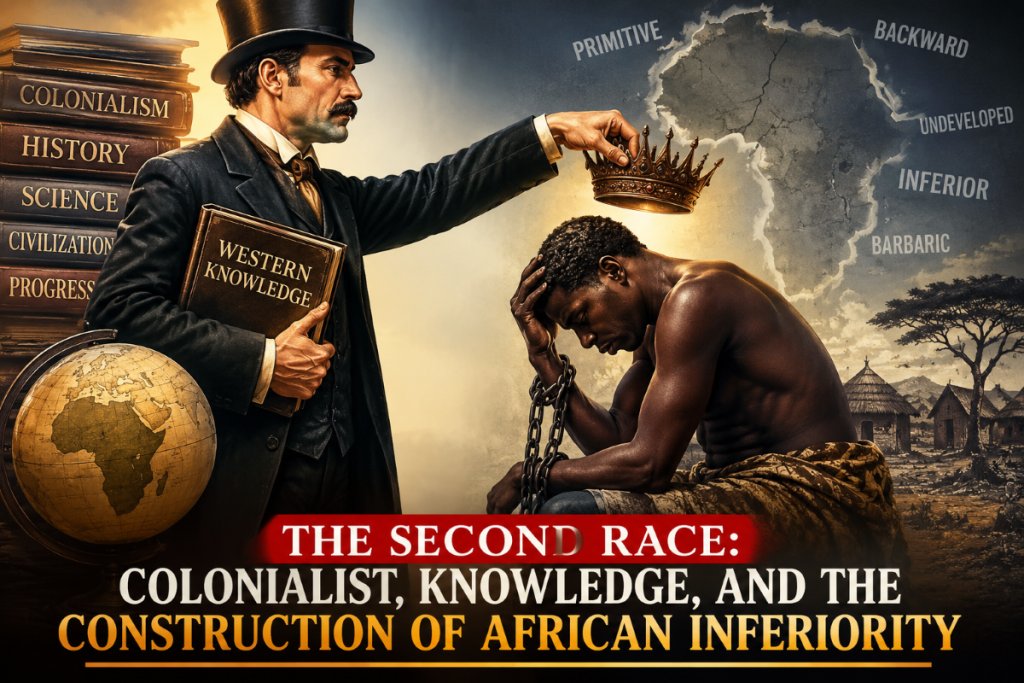
Colonialism sought not only to conquer African territories but also to redefine African humanity itself. By constructing Africanness as the antithesis of civilization, reason, modernity, and progress, colonial discourse cultivated a psychology of inferiority whose effects continue to shape African identity, institutions, governance, and aspirations
The most enduring legacy of colonialism is therefore not territorial occupation but psychological conquest. This psychological conquest was sustained through an equally important epistemological project. The project sought to determine who could produce knowledge, define progress, establish standards of civilization, and shape the future. The result was a world in which the West became the reference point against which Africa measured itself.
Growing up in rural Kenya, there was an ever-present feeling that Kenya, and by extension Africa, was a ‘ warm-up station’ rather than a destination: that there was something better on the other side; a greener pasture. There was an equally persistent nudge, both implied and explicit, from my mother to work hard and go to America. To acquire the premium knowledge and prestige associated with Western education and life, just as many celebrated African trailblazers had done before. Perhaps, as village folklore would suggest, one could even return with a pearl-white wife as the ultimate symbol of success.
What made this belief remarkable was that it came from my mother, a person who had neither travelled outside Kenya nor completed secondary school. Yet she was convinced that American and European education represented the highest form of learning available to mankind. Just as Frantz Fanon observed, the colonized often come to view the colonizer’s world as the ultimate horizon of human achievement.
Core Argument
This phenomenon reflects a deeper intellectual condition. Although formal colonialism ended, Africa remains trapped in coloniality, a system of power that survives through knowledge, culture, language, governance, and economic structures. Genuine liberation requires the decolonization of the African mind through the rejection of Eurocentric epistemologies and the reconstruction of African-centered ways of knowing.
Philosopher Reiland Rabaka, in Against Epistemic Apartheid, argues that colonialism denied Africans the authority to define knowledge and reality on their own terms. Consequently, African understandings of development, democracy, governance, education, and progress have frequently been filtered through European conceptions. African knowledge itself is often categorized as “traditional” or “indigenous,” as Mumbi Mcharia argues, labels that frequently relegate it to the margins, while Western knowledge is assumed to be universal, modern, and superior. Over time, Africans have increasingly internalized these distinctions and begun to view their own intellectual traditions through the eyes of others.
For the longest time, a rigid system of European epistemic apartheid has confined Africa within blanket, universalized definitions of key human concepts. Through colonial and neocolonial educational curricula, Western thought established itself as the sole architect of truth, systematically engineering how Africans perceive themselves and their capabilities. Within this manufactured framework, every major concept, be it development, religion, governance, or knowledge, was defined in a way that inherently guaranteed Africa would always get the short end of the stick. By anchoring “civilization” to European historical trajectories, African spiritual systems were reduced to primitive superstition, and organic socio-economic growth was mislabeled as backwardness. This structural weaponization of definition did not just distort African history; it actively hijacked its future by forcing its people to evaluate their worth through the gaze of their oppressors. The following analysis unpacks these stolen definitions, demonstrating how rewriting these foundational concepts is the first step toward dismantling this epistemic siege.
Development
Few concepts illustrate the psychology of inferiority more clearly than development. Contemporary understandings of development are largely measured through standards established by Western institutions. Gross Domestic Product, industrialization, technological advancement, infrastructure, and liberal democratic governance have become the accepted benchmarks through which societies are evaluated.
By these standards, Africa is perpetually portrayed as lagging. The United Nations developed a framework for classifying countries as developed, developing, or least developed. These metrics are paternalistic and Eurocentric, as they rank nations using criteria derived primarily from Western economic models. While these labels are meant to quantify progress, they frequently position African nations at the bottom of the hierarchy. The implication: Africa is not simply behind; it is incomplete. It is forever striving toward a destination already occupied by ‘developed’ nations.
Such classifications have consequences beyond economics. They shape how Africans perceive themselves and their possibilities. They create the impression that opportunity exists elsewhere and that success requires proximity to Western institutions. The village child dreaming of America is not merely pursuing prosperity; he is pursuing a standard of value that has been defined outside his own society.
The irony is profound. Just like it was argued by economists Raúl Prebisch, Hans Singer, and Immanuel Wallerstein, the proponents of Dependency Theory or World Systems Theory. Who contended that the global economic hierarchy naturally exploits LDCs to benefit developed nations. Many of the nations considered the most developed accumulated significant portions of their wealth through centuries of exploiting African labour and resources. The transatlantic slave trade supplied free labour that contributed immensely to the growth of European and American economies. Coloniality still ensures a continuous flow of raw materials from Africa to industrial centers abroad.
The story of Haiti demonstrates this contradiction with painful clarity. Having defeated the world’s most powerful colonial empires and abolished slavery, Haiti was subsequently forced to compensate former slave owners for the loss of their “property.” A nation born from liberation was immediately trapped in debt. The consequences of that arrangement continue to influence Haiti’s development today.
The issue, therefore, is not whether Africa faces developmental challenges; it undoubtedly does. The issue is whether the standards by which development is measured are sufficiently universal or whether they continue to reflect the historical experiences and priorities of a particular civilization while presenting themselves as objective truths.
Language
Perhaps no colonial legacy is more visible than language. Across Africa, social mobility, education, law, governance, and international engagement are overwhelmingly conducted through European languages. English, French, Portuguese, and Spanish often enjoy greater prestige than indigenous languages spoken by millions. African nations are described as being anglophone, francophone, lusophone, and hispanophone, while the languages are consistently used by hardly 20% of the population in each country.
The European portryaed the African language as something that would drive disunity among Africans, and that nationalism was to be nurtured using the white man’s language. That which was ours was bad: Africa had to part with languages which our forefathers had used in trade, intermarriages, and war. And instead embrace French, English, and Spanish as the hallmark of sophistication. This made language the most important vehicle through which the colonizer’s power fascinated and held the African soul prisoner.[1]
Language is not merely a tool of communication; it is a carrier of memory, culture, and worldview. When people lose confidence in their language, they gradually lose confidence in the ideas and experiences embedded within it. Ngũgĩ wa Thiong’o has long argued that language was one of colonialism’s most effective weapons. By elevating European languages and marginalizing African ones, colonial systems ensured that Africans increasingly interpreted their reality through foreign conceptual frameworks.
The consequences remain evident today. A child who speaks flawless English is often considered more educated than one who possesses deep mastery of an African language. Universities produce graduates capable of discussing European philosophers in great detail while remaining unfamiliar with the intellectual traditions of their own communities. The result is not bilingualism but intellectual dependency.
The question is not whether Africans should abandon global languages. No, in fact, Ngugi says that knowing global languages is empowerment, if you already know your own language. In an interconnected world, multilingualism is an advantage. The question is why African languages continue to occupy a subordinate position within African societies themselves.
[1] Ngũgĩ wa Thiong’o, Decolonizing the Mind (James Currey 1986)
Reflections
The generation that witnessed independence approached it with enormous optimism. Euphoria swept through the African continent before and soon after African territories hoisted flags, sang national anthems, and celebrated the rise of African leaders to power.[1] Africans believed then that they had parted ways with the invader, that therefore Africans could move forward unhindered to enjoy the freedom and prosperity they thought in immediate grasp.[2] Across the continent, men and women believed that political freedom would usher in a new era of dignity, prosperity, and self-determination. Similar optimism accompanied the Haitian Revolution and the emancipation of enslaved Africans in the Americas.
This was not so. Optimism alone could not erase the structures that colonialism left behind. The euphoria and rising expectation soon gave way to disappointment and despair because colonialism left behind enduring legacies. Political independence did not automatically produce intellectual independence. Economic dependence persisted. Imported institutions remained intact. The assumptions through which Africans viewed themselves remained largely unchanged. The European domination was alive.
Many Africans, therefore, found themselves in a paradoxical situation. The colonial flag had been lowered, but the colonial mindset remained. This psychological inheritance became the foundation upon which neo-colonialism flourished. As Jaramogi Oginga Odinga recounted in Not Yet Uhuru, colonial rule demanded that Africans abandon their supposedly backward ways in favour of modern alternatives defined by the colonizer. Today, much of this process occurs voluntarily.
The evidence can be seen in everyday life. African films compete against Hollywood productions for African audiences. African football leagues struggle for attention while European clubs command passionate followings across the continent. Global celebrities often enjoy greater recognition among African youth than local artists, writers, or intellectuals. A sophisticated person is often imagined as someone who supports Arsenal, listens to Taylor Swift, and consumes Western culture, while local cultural products remain secondary.
This is not a criticism of cultural exchange. It is an observation about cultural hierarchy. The problem arises when Africans consume global culture while simultaneously undervaluing their own.
[1] Hussein A Bulhan, ‘Stages of Colonialism in Africa: From Occupation of Land to Occupation of Being’ (2015) 3(1) Journal of Social and Political Psychology 239, 245. [1]
[2] Ibid
Solutions
Many conversations about decolonization remain trapped at the level of rhetoric. Africans frequently speak about decolonization without clearly articulating what it should look like in practice. If the colonial project began in the mind, then meaningful decolonization must begin there as well.[1]
First, African education systems must place greater emphasis on African intellectual traditions. Students should learn not only about European philosophers, political theorists, and historical figures but also about African thinkers who shaped the continent’s understanding of governance, morality, and society.
Second, African languages should be elevated within education, government, and public discourse. Language preservation is not merely a cultural project; it is an intellectual one. A people confident in their language are more likely to be confident in their worldview.
Third, African societies should critically reassess imported institutions rather than accepting them as universal. Development, democracy, and governance should be adapted to local realities and historical experiences instead of being measured exclusively through foreign frameworks.
[1] Ngũgĩ wa Thiong’o, Decolonising the Mind: The Politics of Language in African Literature (James Currey 1986)
Finally, Africa must invest in its own cultural production. Literature, film, music, research institutions, and local industries shape how societies understand themselves. A continent that consumes only the stories of others eventually forgets how to tell its own.
Conclusion
The greatest achievement of colonialism was not the occupation of African territory but the construction of African inferiority. By defining Africanness as the opposite of civilization, progress, and modernity, colonial discourse created a psychology whose effects continue to influence how Africans understand themselves and their place in the world.
Yet this legacy is neither permanent nor irreversible. Africa’s future does not depend on rejecting modernity, isolating itself from the world, or romanticizing the past. It depends on recovering the confidence to define development, governance, knowledge, culture, and progress on its own terms.
The challenge before Africa is therefore not simply political or economic. It is intellectual and psychological. The task of this generation is to reclaim the authority to tell Africa’s story for itself. Only then can Africa cease to exist as the world’s “second race” and instead emerge as a civilization fully confident in its own humanity.