
How to Choose the Right Leader: Is the Current Government Worth Voting For Again?
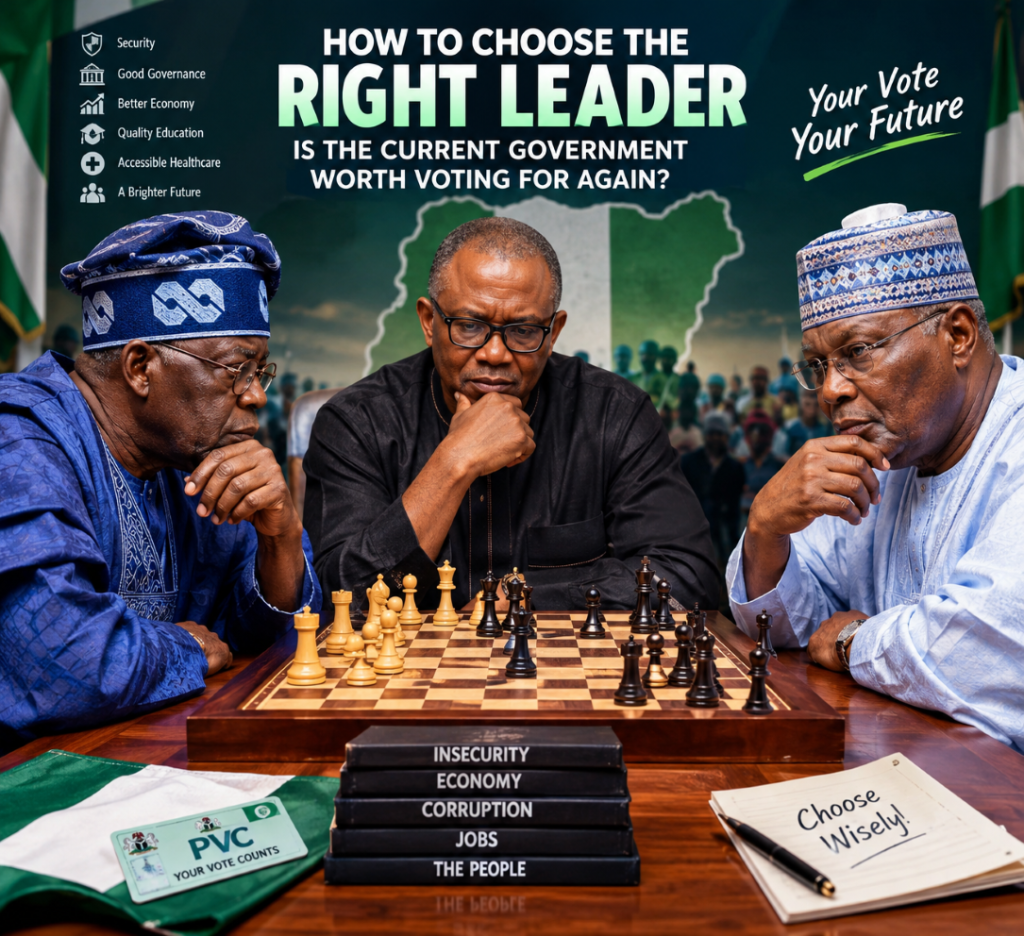
How to Choose the Right Leader: Is the Current Government Worth Voting For Again?
By: Bassey Margaret
Introduction
Elections are an important part of democracy because they give citizens the opportunity to choose who governs them. In Nigeria, voting is more than standing in a queue to thumbprint a ballot paper. It is a decision that can affect the price of food, the cost of transportation, the safety of our communities, the availability of jobs, and the future of our children.
As Nigeria approaches another presidential election, citizens have important questions to ask. Has the current government improved their lives? Are people safer than they were before? Can workers survive on their salaries? Are public funds being used for the benefit of ordinary Nigerians?
These questions matter because a government should be judged not only by what it promises, but also by its actions, results, and willingness to accept responsibility when things go wrong.
President Bola Ahmed Tinubu took office on 29 May 2023. Since then, his administration has introduced major economic changes, including removing the petrol subsidy and changing foreign exchange policies. The government has defended these measures as necessary reforms, but they have also contributed to serious financial pressure on households. Other factors, including exchange-rate changes, transport costs, insecurity, and global prices, have also affected the economy.
The central question is therefore simple: how should Nigerians assess the current administration, and what should they consider before choosing their next leader?
Insecurity: Why Are Nigerians Still Being Killed and Kidnapped?
One of the most important responsibilities of any government is to protect the lives and property of its citizens. People should be able to travel, attend school, go to work, worship, and sleep in their homes without constantly fearing armed attacks.
Unfortunately, insecurity remains a serious problem in Nigeria. Kidnappings, banditry, insurgency, and attacks on rural communities continue to affect many families, particularly in parts of the North-West, North-East, and North-Central regions. Human Rights Watch documented continued killings and kidnappings during 2025, including attacks on communities in Plateau and Benue states.
Imagine a farmer in Zamfara who is afraid to visit his farm because armed men might attack him. If he cannot farm, he loses his income. If thousands of farmers face similar threats, food production can suffer, and food prices may rise. Children may also miss school when parents fear sending them out.
The question Nigerians should ask is: what has the government done to protect these people, prevent repeated attacks, arrest the perpetrators, and bring those responsible to justice?
It is important to understand that insecurity has several causes, including criminal networks, armed extremist groups, local conflicts, and weaknesses in security institutions. There is no established evidence that the president deliberately permits kidnappings and killings. However, the government has a responsibility to improve security, respond effectively to threats, investigate attacks, and protect vulnerable communities.
A government cannot prevent every crime, but citizens have the right to demand better security and accountability when people continue to suffer.
The Rising Cost of Fuel and Food
Another major concern for Nigerians is the cost of living. Many families struggle to afford basic necessities such as rice, garri, beans, bread, cooking gas, and transportation.
For example, imagine a mother who earns ₦100,000 monthly. She has to pay rent, buy food, pay for transportation, and support her children. If the cost of food and transport rises but her salary remains the same, she will have to reduce what she buys or borrow money to survive.
This is one reason economic policies matter to ordinary citizens.
In 2023, the Tinubu administration removed the petrol subsidy. The government argued that maintaining it was expensive and that the money could be redirected towards public services and development. However, the change contributed to higher petrol and transport costs, placing additional pressure on households and businesses. Changes in the exchange rate and other economic conditions have also contributed to rising costs.
The government should therefore be judged on more than its explanation for removing the subsidy. Nigerians should examine whether the savings have produced visible benefits, whether support reaches vulnerable families, whether transportation has become affordable, and whether food prices are manageable.
For instance, if a government claims that economic reforms will eventually improve living conditions, citizens should ask when those improvements will become visible and how people struggling today will be supported in the meantime.
Economic reform should not be measured only by government revenue or financial reports. It should also be measured by whether ordinary people can afford to live.
Poor Wages and the Struggle to Survive
Workers are another group facing serious difficulties. Many Nigerians work every day but still struggle to provide for themselves and their families.
Nigeria introduced a new national minimum wage of ₦70,000 in 2024. However, even where this wage is paid, its purchasing power can be limited when food, housing, electricity, and transportation consume most of a worker’s income.
Consider a security guard, cleaner, shop assistant, or junior civil servant who earns a modest salary. After paying for transport to work and buying food, very little may remain for rent, healthcare, school fees, or savings.
This raises an important question: what does economic progress mean if workers cannot afford basic necessities?
When choosing a candidate, Nigerians should examine proposed wage policies, employment plans, support for small businesses, and the candidate’s record of implementing promises.
Citizens should also ask whether wage increases are accompanied by policies that help control living costs. A higher salary means less if prices rise so quickly that the money buys fewer goods.
Corruption and the Use of Public Money
Corruption is a major problem that deserves public attention in Nigeria. Government revenue belongs to the people and should be used to improve their lives, not diverted for private benefit. Money meant for roads, hospitals, schools, electricity, security, and poverty reduction should produce results that ordinary Nigerians can see and benefit from.
Imagine a community where the government promises to build a hospital, but the project is abandoned after public money has been allocated. Pregnant women may have to travel long distances to receive medical care, while sick children may struggle to get treatment. If money has been mismanaged or stolen, the consequences go beyond financial loss. People’s lives may be affected.
One example that raises important questions about public spending is the Lagos–Calabar Coastal Highway, a major road project introduced under President Bola Ahmed Tinubu’s administration.
In 2024, the Federal Government announced that the first 47.47-kilometre section of the highway in Lagos had a contract cost of approximately ₦1.068 trillion. This amount covered that particular section, not the entire proposed 700-kilometre highway. The project’s cost and financing arrangements attracted public debate, with questions raised about procurement, transparency, and how such a large amount of public money would be accounted for.
The highway is intended to improve transportation, connect coastal communities, support businesses, and create economic opportunities. However, when a project costs trillions of naira, Nigerians have a right to ask important questions: How much money has actually been paid? How much work has been completed? Is the project delivering value for money? Are the contract details and expenditure records available for public scrutiny?
The issue goes beyond one road. Nigeria needs a system in which every major government project is properly monitored, contracts are transparent, payments are documented, and independent audits can identify irregularities. When a project is delayed, redesigned, or abandoned, the government should explain why, how much has been spent, what has been achieved, and what happens to any unspent funds.
Nigeria continues to face concerns about corruption and weak accountability. The BTI 2026 Nigeria report identifies corruption as a problem that undermines public trust, while other assessments highlight continuing governance challenges.
This matters because Nigeria has many competing needs. While billions or trillions of naira may be committed to infrastructure, some communities still lack adequate hospitals, schools, clean water, and reliable electricity. Nigerians deserve to know whether public spending is balanced against these needs and whether projects are selected and managed in the public interest.
Before voting, citizens should examine candidates’ records on transparency, public procurement, financial accountability, and the investigation of credible corruption allegations. They should ask whether candidates will publish government spending records, strengthen independent oversight, and ensure that public officials answer for the use of public funds.
Is the Current Government Worth Voting For Again?
This is a question Nigerians must answer after examining the evidence.
Supporters of the current administration may argue that difficult economic reforms were necessary to address longstanding problems and strengthen public finances. The International Monetary Fund has also acknowledged that recent reforms have improved some macroeconomic outcomes, even as poverty and food insecurity remain serious concerns.
Critics, on the other hand, may argue that the hardship experienced by ordinary citizens, persistent insecurity, and concerns about public accountability show that the government has not delivered enough.
Both the government’s stated objectives and the actual results deserve examination. A fair assessment should consider what has improved, what has worsened, what remains unresolved, and how the administration’s decisions have affected different groups of Nigerians.
For example, voters can ask:
- Has the government made measurable progress in reducing kidnappings and attacks?
- Have its economic policies improved people’s ability to afford food and transportation?
- Are workers earning enough to meet basic needs?
- Have public projects been completed and public funds accounted for?
- Has the government fulfilled its promises, and does it explain its failures honestly?
Why Voting for Another Candidate Matters
Democracy gives citizens the opportunity to choose their leaders and, when necessary, choose different ones. Elections provide a peaceful way to reward good performance or reject leadership that citizens believe has failed to meet their expectations.
If voters are dissatisfied with an administration, they can consider another candidate whose policies, experience, record, and plans better address their concerns.
However, voting for another candidate does not automatically guarantee improvement. A new leader can also make mistakes or fail to fulfil promises. That is why Nigerians should not simply reject one person without carefully examining the alternatives.
For example, if a candidate promises to reduce food prices, voters should ask how that person plans to achieve it. Will the candidate support farmers, improve roads that transport food, reduce insecurity in farming communities, or provide practical assistance to vulnerable households? What evidence suggests the plan can work, and how will progress be measured?
Similarly, a candidate who promises to end corruption should explain how public contracts will be monitored, how financial records will be made transparent, and how independent institutions will be protected.
The goal should not be to vote for someone merely because they belong to a different party. It should be to choose a leader whose plans are realistic, whose record can be examined, and whose actions can be held accountable.
How to Choose the Right Leader
Before voting, Nigerians should consider the following:
- Examine the candidate’s record. Look at previous responsibilities, achievements, failures, and how the candidate handled public resources.
- Study the candidate’s policies. Promises about jobs, security, education, healthcare, wages, and food prices should include practical plans.
- Look beyond party loyalty. A party’s name, slogans, or popularity should not replace an examination of its candidate’s record and policies.
- Reject vote buying. Money or gifts offered in exchange for votes may provide temporary relief, but they do not guarantee responsible leadership.
- Verify information. Check claims against credible news reports, official documents, and independent investigations instead of relying only on social media posts.
- Demand accountability. Remember that the responsibility of citizens does not end after election day. People should continue asking elected officials to explain their decisions and fulfil their promises.
Conclusion: Your Vote Is Your Responsibility
Nigeria’s challenges cannot be solved by changing a president alone. Security agencies must perform their duties, public institutions must work, corruption must be addressed, and economic policies must produce meaningful benefits for citizens.
Nevertheless, elections are an important opportunity for Nigerians to influence the country’s direction.
The current government should be assessed through its documented performance, just as every alternative candidate should be assessed through their own record, policies, and promises. Neither political loyalty nor anger should prevent voters from asking difficult questions.
If Nigerians believe the current administration has delivered sufficient progress, they can consider that evidence when making their decision. If they believe it has failed to meet their expectations, they can examine other candidates and decide whether an alternative offers a more convincing plan.
The most important question is not simply whether Nigerians should vote for or against the current government. It is whether the person they choose has a credible plan to make the country safer, improve living conditions, protect public resources, and serve the people.
A vote is not merely a mark on a ballot paper. It is an opportunity to demand responsible leadership and help shape Nigeria’s future.
If you are tired of insecurity, rising food prices, unemployment, corruption, and poor living conditions, do not remain silent. Get your PVC, come out to vote, and make your choice count! Do not allow anyone to intimidate you or decide your future for you.
Nigeria belongs to all of us, and its future is in our hands. Your vote matters. Your voice matters. Come out and vote for the Nigeria you want to see!